
 Figma
 API
 Web to code extension
 Adobe XD
 Discord
 Twitter
 GitHub


 Blog

Spacefast Review: AI Publishing, Versions, Comments, Pricing, Pros and Cons23 min read
Reading Time: 14 minutesYou asked ChatGPT or Claude for a landing page, a deck or a small app, and it looks good in the chat. Then comes the part nobody enjoys: where does it live, who can open it, and what happens when someone wants one thing changed?
Spacefast is Automattic’s answer. It is a hosting and publishing layer for whatever your AI builds. You tell ChatGPT, Claude, Cursor, Codex or another agent to put the work on Spacefast, and a link comes back in the chat. Each project is private until you share it, every publish becomes a version you can roll back, and people can leave comments on the page itself. Automattic opened it to everyone on November 9, 2026, and there is a free plan.
This Spacefast review is for people deciding whether to host agent-made work there. It covers what you get, what it costs, where it is still thin, and how it compares with AgentGrid.io. One note on bias: I run Anima, the company that builds AgentGrid.io, so I will say plainly where Spacefast is the stronger pick.
The two products overlap on one habit, a link that your agents keep updating. AgentGrid.io is a shared workspace where people and AI agents create, review and edit the same documents, apps and files, with one live version and a history of who changed what. Spacefast is built to put a site or app online. AgentGrid.io is built to keep the work itself moving between people and agents. The comparison further down shows where each one fits.
What is Spacefast?
Spacefast is a platform from Automattic, the company behind WordPress.com, WooCommerce, Tumblr and Jetpack, for publishing what AI agents make. Its homepage is blunt about the category: Spacefast is not an AI builder. It has no model of its own. You keep working in the AI you already use, and Spacefast gives that agent the hosting, database, sharing controls and instructions it needs to put the result online. Automattic says it charges for infrastructure, not AI credits, so you do not pay for inference twice.

Each thing you publish lives in a Space: one site with a stable address, a set of versions and its own sharing settings. Spaces get an address like name.space.fast, and you can attach your own domain.
The product has a short history. Batuhan İçöz, who now leads Spacefast as founder and CEO, started it as a static hosting service during Automattic’s Radical Speed Month. Friends without technical backgrounds kept sending him projects they had made with AI and asking for help with GitHub. Users wanted a backend, so he kept building. Spacefast soft-launched in September 2026 and became its own company, and the public launch on November 9 is the one most people have seen. It was also covered by TechCrunch, which put it next to AI builders such as Lovable and Emergent while noting the founder’s pitch that Spacefast lets you choose your own agent.
How does publishing to Spacefast work?
The main route is a sentence. Connect Spacefast to your AI once, then ask it to publish. Spacefast ships tool descriptions and instructions written for the agent, so the agent already knows how to deploy a folder or add a database. A few seconds after the upload finishes, the chat shows a link. Spacefast’s FAQ says a new version is usually live within ten seconds.
Connecting depends on where you work. Automattic lists official plugins for Claude, ChatGPT, Grok Bot, Cursor and Antigravity, and a listing in GitHub’s MCP registry. Everything else goes through the hosted MCP server, a command-line tool, or the API. The docs carry setup guides for more than 25 agents and editors, including Claude Code, Codex, VS Code, Gemini CLI, Hermes and OpenClaw. If you prefer to skip the agent, there are three other ways in:
- Drop: drag a folder or zip onto drop.fast. No terminal and no account.
- Git: connect a repository. Pushes to
maingo live and other branches get preview links. - CLI: run
npx spacefast publishfrom a terminal.
You can publish static HTML, presentations and games, and apps built on supported Next.js, Astro, TanStack Start, Vite and PHP paths. The docs say runtime features depend on the deployment path, so check the framework guide before your agent starts.
You do not need an account for a first publish. You get a live address and a private claim link. The catch is the clock: an unclaimed Space normally expires 33 hours and 20 minutes after it is created or last changed, capped at 30 days from creation. Claiming the Space removes that deadline. You can claim a Space using a Spacefast account created with an email code; WordPress.com, Google and GitHub may also be offered as sign-in options.
If you already publish agent output through a chat, the same pattern shows up in our guides to publishing a website with ChatGPT and with Claude Code.
What do you get in a Space?
Versions and rollback
A publish that changes files creates a version, a frozen snapshot with its own permanent address. The live address points at one version, and rolling back just moves that pointer to an earlier one. Spacefast’s docs say nothing is rebuilt, so a rollback takes effect in seconds. Retained versions follow your plan’s history policy, and deleted or expired versions cannot be restored.
Fatih Kadir Akın, who the founder lists as part of the core team, showed what this looks like in practice. His agent kept improving a browser game hour by hour and deployed every change to Spacefast, with each version kept so the first and latest builds can be compared.
Sharing and access
New Spaces are private, and the URL alone grants no access. Spacefast treats access as a set of grants you can combine: the public, your team, invited people by email, anyone holding a share link, or anyone who knows a password. Each grant carries a role. A viewer can read, a commenter can also write comments, and an editor can publish. Share links and passwords cap at viewer or commenter, so a forwarded link can never publish. Revoking a link takes effect on the next request, and search indexing is a separate switch.
For client and stakeholder review, this is the strongest part of the product. You can hand someone a link or a password without adding them to your team, and reviewers and commenters do not count as paid members.
Comments your agent can act on
Comments are Spacefast’s collaboration feature, and they are included on every plan. People leave a comment on the part of the page they mean, and Spacefast lists live comment updates on every plan. The point is the loop that follows. Automattic says you can work through feedback with teammates and clients on the page, then ask your AI to make the changes. One feature from the roadmap, drawing on the page while you give feedback, is marked Soon in the docs.
Comments become text that flows back into an agent that can publish, so it is worth limiting what that agent is allowed to do. Spacefast describes approval checks for sensitive actions such as rollbacks and DNS changes, and you can choose what each agent may access.
Database, uploads, domains and Git
This is where Spacefast goes beyond sharing. Every Space comes with a MySQL-compatible database, file uploads and traffic stats, with nothing to set up first. Apps can run server code through Functions or a TypeScript runtime called Zero, and scheduled jobs are supported. Custom domains come with managed HTTPS, even on the free plan, and domains can be bought at cost. Git is built in, with preview links for branches. Automattic says Spacefast runs on the same infrastructure as WordPress.com and Tumblr.
How much does Spacefast cost?
Spacefast is free to start. The Personal plan costs $0, needs no card, and every plan allows commercial use. Prices below are from the pricing page as of November 2026, in US dollars before tax.
| Plan | Price | Included usage | Spaces and custom domains | Members |
|---|---|---|---|---|
| Personal | $0, no card | $1 a month | 20 and 20 | 1 |
| Go | $5 a month | $5 a month | 100 and 100 | 1 |
| Pro | $15 a month | $15 a month | 500 and 500 | Free up to 5, then $15 a month each |
| Enterprise | Custom | By contract | Custom | By contract |
The plan price is only half of the bill. Included usage pays for every metered resource, resets each month and does not roll over. Past that, you pay listed rates, for example $0.1188 per CPU-hour of compute and $0.04 per GB of uncached traffic. Several meters, including storage and some compute, are free for a limited time while Spacefast finishes measuring them, so today’s bill will not match the eventual one. Go and Pro can set a spending cap that starts at twice the plan price. On Personal, once the $1 is used, new builds and Workers pause, but sites that are already deployed keep serving.
Go adds hourly database backups and a choice of datacenter. Pro adds team roles and wildcard domains. Boost is an add-on at $9 per Space a month that raises one Space’s compute, disk and memory. Enterprise adds SSO, SAML and SCIM. The docs also list a Business plan as coming soon. Launch-day coverage differed from the pricing page on a few details, such as how many Spaces Go includes, so use the live page before you plan around a number.
What are early users saying?
Most of what is public comes from the soft-launch weeks, so read it as early impressions. Onur Ozcan, who builds with agents, was given early access and had Claude Code move a project over from Cloudflare.
The most detailed independent write-up I found is Casey Burridge’s first look from October 5. He had Claude Code build a live tracker with its own database and a scheduled job in about 15 minutes, and he drew a useful line between Spacefast and a Claude artifact: an artifact is a single page that lives inside Claude, while a Space is a real website with its own address, versions you can roll back and, if you need it, a backend. He also reported rough edges. The setup link works like an admin credential and expires after about 15 minutes. Each scheduled run gets about five seconds. One project template contradicted the docs. That review predates the launch, and Automattic may have changed some of it since.
If you are weighing Spacefast against a Claude artifact, our guide to sharing and publishing Claude artifacts covers the other side of that choice.
Spacefast pros and cons
Where Spacefast is strong
- Bring your own AI. It works with the agents you already pay for, and your projects stay put if you switch.
- Private by default, with flexible sharing. Links, passwords, invites and roles cover most client-review needs.
- A real backend. Database, uploads, functions, cron, domains and Git are included, which lets one tool host a page or a small app.
- A version for every publish. Rollbacks do not rebuild anything.
- A free plan that allows commercial use, with custom domains included.
- Automattic behind it, with SSO and a support SLA on Enterprise.
Where it is still thin
- It is new. The public launch was on November 9, 2026.
- Parts are unfinished. Automattic described built-in app authentication as coming soon at launch, while the current pricing table labels Space users and sign-in, transactional email and team memories as beta. Service connectors are marked soon. Verify each feature in your account before depending on it.
- Leaving takes work for apps. Static sites usually move to another host as they are, but apps built on Spacefast runtimes need code changes and their data exports separately.
- Metered costs. The free plan has $1 of usage, and several meters are only free for now.
- Teams need Pro. Personal and Go allow one member, and claiming a Space needs a Spacefast account, which you can create with an email code.
- Anonymous links expire after 33 hours and 20 minutes unless you claim them.
Spacefast vs AgentGrid.io: how they differ
Both put agent-made work behind a link that people can comment on, and both keep versions. They are built for different jobs. Spacefast is a host. Its own comparison pages set it against here.now, Netlify Drop, Cloudflare Workers and GitHub Pages. AgentGrid.io is the shared workspace around the work: documents, decks, reports and apps that people and several agents keep editing together, with share kept separate from publish.
| Spacefast | AgentGrid.io | |
|---|---|---|
| Made by | An Automattic company since its September 2026 soft launch; open to everyone since November 9, 2026 | Anima App, Inc. |
| What it is | A hosting and publishing layer for sites and apps your AI builds | A shared workspace where people and agents create, review and keep editing the same artifacts |
| What you keep there | Static sites and framework apps, with an optional database, uploads and functions | Apps (HTML or React), Markdown documents and other files, each with one address and one history |
| Connecting an agent | Official plugins for Claude, ChatGPT, Grok Bot, Cursor and Antigravity, plus MCP, CLI and API | Claude connector, ChatGPT plug-in, CLI login for coding agents such as Claude Code, Cursor and Codex, and one-time invites |
| Sharing beyond the team | Invited people, share links, passwords or public | Add people to the team and a workspace, or publish a public URL |
| Comments and review | Comments pinned to the page, with roles for commenters and viewers | Review comments anchored to an app element or document passage, with mentions and assignment to an agent |
| Versions | Immutable version per publish, rollback without a rebuild | History shows each change with its author, person or agent, and supports Compare, Restore and branch previews |
| Agent permissions | Approval checks for sensitive actions | Each agent has its own name and Read, Write, Share and Publish capabilities, revocable at any time |
| Editing | Mostly through your agent, Git or the CLI | Through your agent, a rich editor for documents, and Canvas for visual edits to apps |
| Backend | MySQL-compatible database, uploads, functions, cron | Pages, documents and files. The docs do not describe a built-in database or server runtime |
| Custom domains | Included on every plan | Paid plans, for published artifacts |
| Pricing start | Free Personal plan with $1 of usage, paid from $5 a month | Free plan with Publish to Web, paid plans add capacity and custom domains. Agents never use seats |
| Best for | Putting an agent-built site or small app online, with a backend if needed | Keeping team documents, decks, reports and apps current while people and agents work on them together |
Where Spacefast wins is easy to name. It is the better home for a site or app that needs a database, a custom domain and Git previews, and it is more flexible about letting an outside reviewer in. AgentGrid.io’s docs describe two ways to reach someone outside the team: add them to a workspace, or publish a public URL. They do not describe a password-protected link.
Where AgentGrid.io wins is the work that happens before and around publishing. A document or deck is one artifact that a person, Claude and ChatGPT can all edit, and History records which of them changed what. Review lets you pin a comment to one element or passage and assign the fix to an agent that already has access. Publishing is a separate, deliberate step.
What shared review looks like in AgentGrid.io
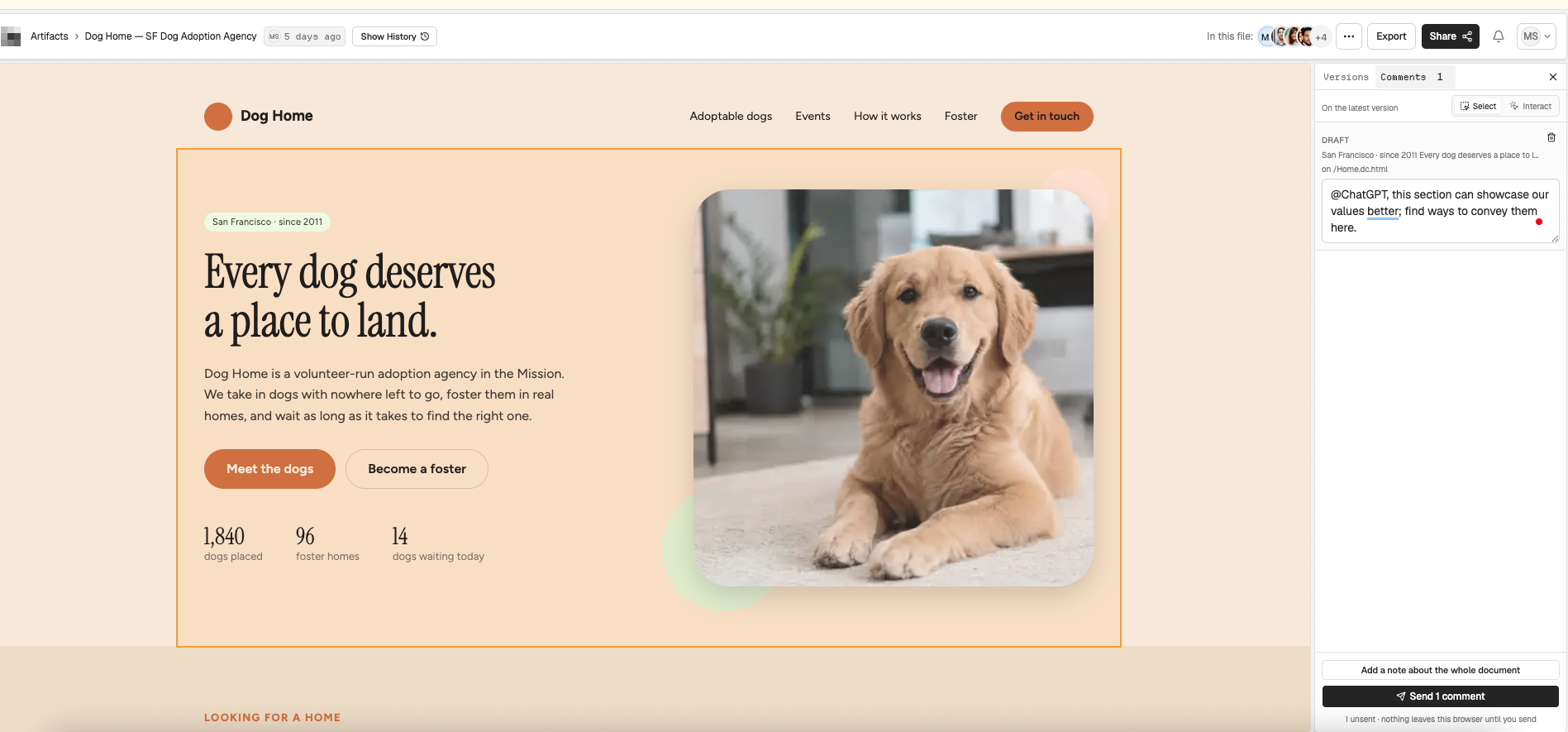
Here is how those pieces appear in the product. An artifact opens as a live page or document, with a panel for Versions and Comments beside it.

In Review, you select an element of an app or a passage of a document, write a comment, mention a teammate and assign the follow-up to an agent. Replies stay in the thread, and resolving it closes the discussion without deleting it.
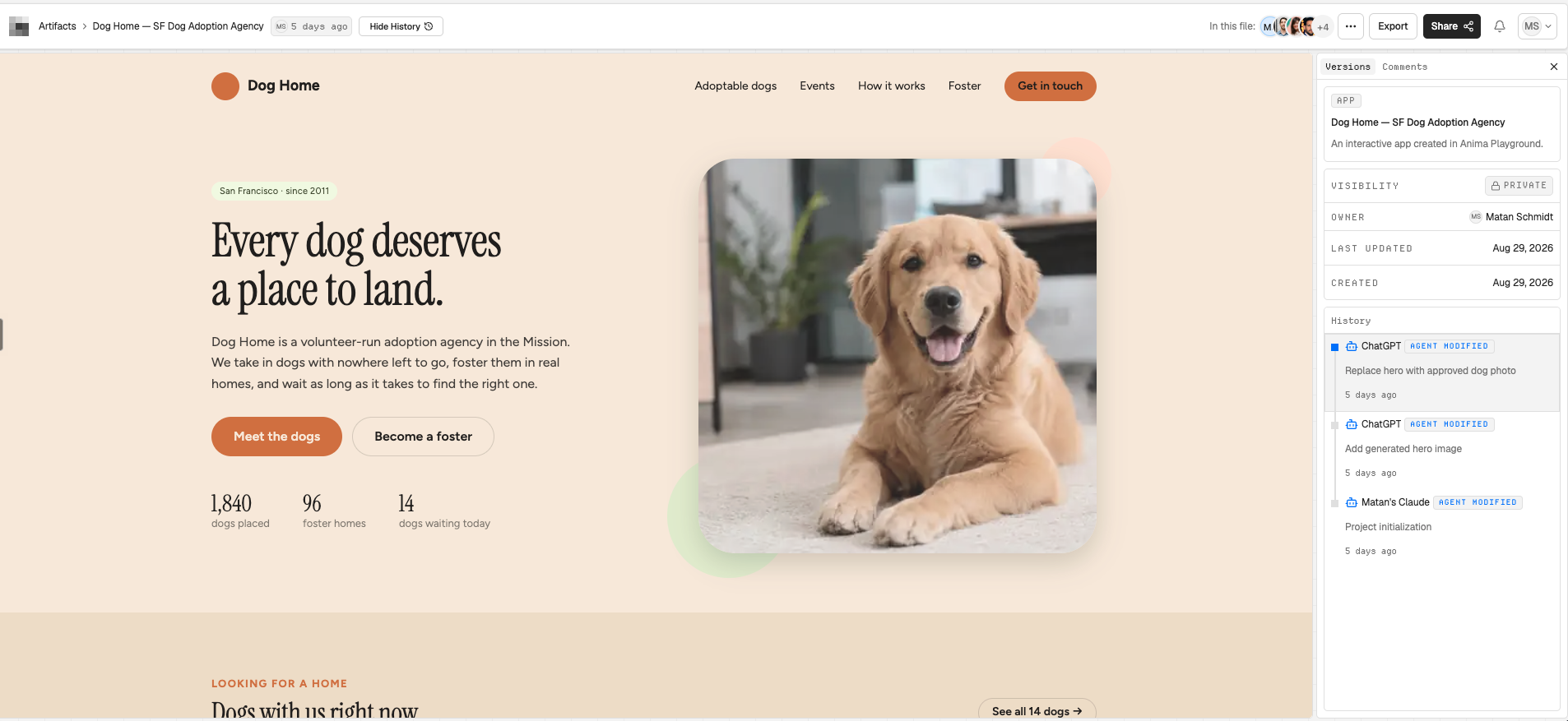
History lists every saved change with its author, whether a person or an agent, and lets you compare a version with the latest or restore it. Restoring adds a new entry rather than erasing the old ones.
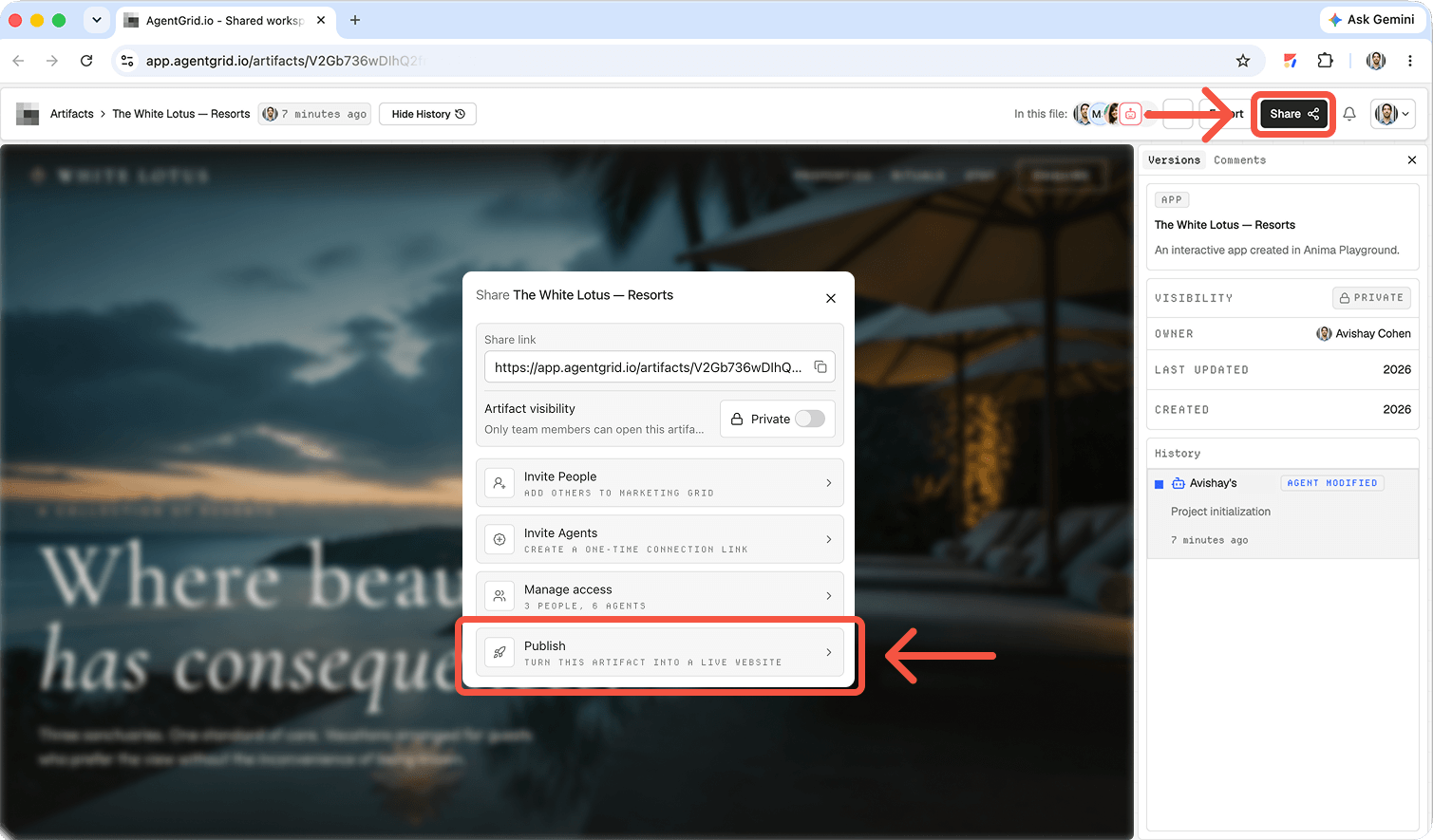
Sharing and publishing stay separate. The Share dialog keeps an artifact private to the people with access, creates a one-time connection link for a new agent under Invite Agents, lists who and what has access under Manage access, and offers Publish as its own step when you want a public website.
What are the alternatives to Spacefast?
The right alternative depends on what you are replacing.
| If you need | Look at |
|---|---|
| A shared workspace where people and agents keep editing the same draft, with review and history | AgentGrid.io |
| A quick public page from a dragged folder | Netlify Drop. Spacefast’s own comparison says it is the better pick when the site will live on Netlify |
| Building blocks for a custom edge app | Cloudflare Workers, which gives you configuration and runtime limits to design around |
| A static site published from a GitHub repository | GitHub Pages |
| Hosting for an app a developer will maintain | A developer platform such as Vercel, which suits Next.js apps under active development |
| An AI builder and host in one product | Lovable or Emergent, which TechCrunch names as Spacefast’s closest builder competitors |
| A page that only needs to exist inside the chat | Your AI tool’s own sharing, such as a Claude artifact or ChatGPT Sites |
Which one should you use?
Use Spacefast when the thing you made is a website or small app that has to be reachable, with a domain, a database or Git previews behind it, and when you want to send a client one link or one password.
Use AgentGrid.io when the thing you made is work in progress that a team and several agents will keep editing: the brief, the report, the deck, the prototype. Review, History and the Share dialog are built for that stage, and you publish only when someone decides to.
They can also sit side by side. Neither product documents a direct integration with the other as of November 2026, so the practical pattern is manual: keep the working draft and its review trail in AgentGrid.io, and put the approved site on the host you prefer. Our post on why we built AgentGrid.io explains the thinking behind that split.
Frequently asked questions
What is Spacefast?
Spacefast is Automattic’s hosting and publishing platform for what AI agents make. You ask ChatGPT, Claude, Cursor, Codex or another agent to put your work on Spacefast and a link comes back in the chat. Each project is a Space with versions, sharing controls and optional comments. It opened to everyone on November 9, 2026.
Is Spacefast free?
There is a free Personal plan with no card, $1 of included usage a month, 20 Spaces and 20 custom domains, and commercial use is allowed. Go is $5 a month and Pro is $15 a month. Usage past the included amount is billed at listed rates, and on Personal new builds pause once the $1 is used while deployed sites keep serving.
Who is behind Spacefast, and is it an AI builder?
Automattic, the company behind WordPress.com, WooCommerce and Tumblr, makes Spacefast, and Batuhan İçöz is its founder and CEO. It is not an AI builder. It has no model of its own, so you keep working in the AI you already use and Spacefast provides hosting, a database and sharing controls.
Do I need an account to publish on Spacefast, and how long does a link last?
No account is needed for a first publish. You get a live address and a private claim link. An unclaimed Space normally expires 33 hours and 20 minutes after creation or its latest publish that changes files, capped at 30 days from creation. Claiming it removes the deadline, and you can create a Spacefast account with an email code; WordPress.com, Google and GitHub may also be offered as sign-in options.
Are Spacefast pages private?
Yes by default. New Spaces are private and the URL alone grants no access. You can invite people by email, create a share link, set a password, or make the Space public. Share links and passwords cap at viewer or commenter access, and search indexing is a separate setting.
Can I leave Spacefast later?
Yes, with a caveat. You can download the files from any retained version, and static sites usually move to another host as they are. Apps built on Spacefast runtimes need code changes to move, and app data exports separately.
What is the difference between Spacefast and AgentGrid.io?
Spacefast is a host for sites and apps your AI builds, with a database, domains and Git. AgentGrid.io is a shared workspace where people and agents keep editing the same documents, apps and files, with anchored review comments, attributed history and separate share and publish steps. Spacefast suits putting a site online. AgentGrid.io suits work that a team is still shaping.
Can I use Spacefast and AgentGrid.io together?
Yes, though neither product documents a direct integration with the other as of November 2026. A simple pattern is to keep the working draft and its review trail in AgentGrid.io, then publish the approved site to the host you choose.